Free app
 Courtovo
The score, on your wrist
Start a match and count points with the bezel or the screen — or simply start a session while you train, and look back later at your heart rate, calories and distance. No account, no sign-in, nothing sent anywhere. Connect a club and the match files itself — that part is yours to switch on, and everything works without it.
For Wear OS. Coming to the Play Store and the Samsung Galaxy Store.
Start here Read the user guide FAQ
With a club
Your matches now reach your club on their own
Connect a Joinovo club account once and every finished match is filed to that club in the background. The line-up comes from the court booking, so there is nothing to type and nobody to spell.
Pairing without a keyboard
An eight-character code, typed into a browser where you are already signed in. Your password never reaches the watch, and you can revoke a watch from your account at any time.
The booking already knows who is playing
With an account connected, the watch offers today's court bookings and fills the line-up from the one you pick. A match played against a stranger is still a name you type.
Heart rate only if you say so
What the watch measured, and a training session with nothing to score, each need their own explicit consent — per club, and withdrawing one deletes what that consent covered.
Signed out, none of this happens and nothing is missing: scoring, history, statistics and measurement work offline, forever.
Counting, not operating
One click of the bezel is one point; a swipe up takes it back. Everything reads at arm's length, in the sun, out of breath. It says when to change ends, too: a mark under the score, and two short buzzes once the undo offer has gone.
Every format
14 ways of scoring, from best of 3 with a match tiebreak through Fast4 to a pro set. Whichever you chose last is already selected next time. Singles and doubles both: the serving order is asked once and worked out from there.
Heart rate, if you want it
Heart rate, calories, steps and distance — each switchable on its own, mid-match too. The frugal mode is the default, so a three-hour match does not flatten the watch.
History and statistics
Every match is stored on the watch and survives a flat battery. Points won on serve, break points converted, longest streak, playing time.
Enter it afterwards
Played without the watch? Add the result from the history: sport, format, day and the sets. Each set is checked against the format's rules as you enter it, so 6-5 never gets saved — and it reaches your club like a match you scored. A retirement or a walkover goes in too.
In your own language
24 languages, chosen on the watch and independent of the phone — English, Hungarian, German, Polish, Greek, Turkish and eighteen more. Every screen is checked to fit in each of them before it ships, because a word that runs off a round display is worth the same as no word.
Training, with nothing to score
Some sessions have no opponent. Start Training and the watch measures instead of counting: heart rate, calories, steps and distance, one figure large and the rest around it, with the time of day above them. It is filed under whatever sport you set — running, golf, yoga.
This is the whole app
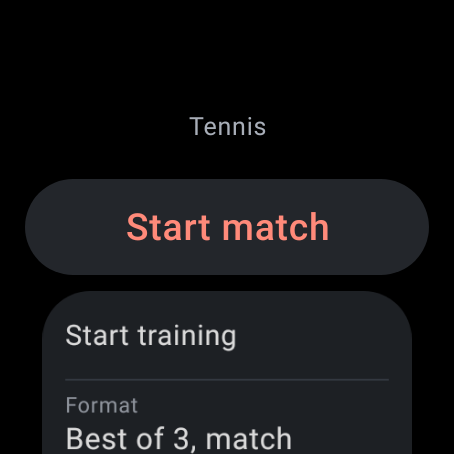
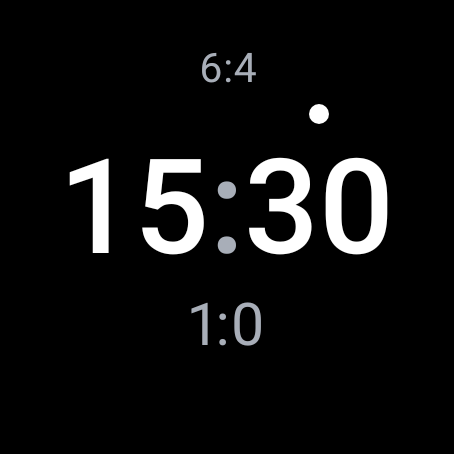
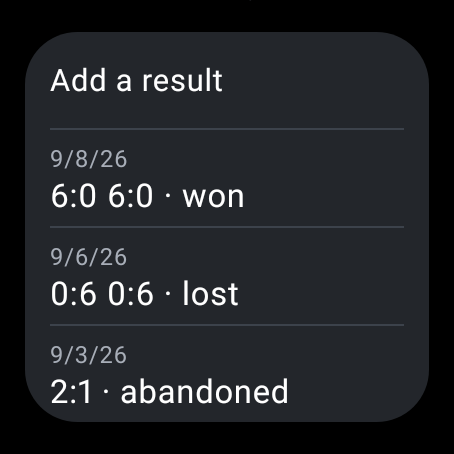
Real screens, taken from the tests that run on every build — not mock-ups.
It does not have to be black
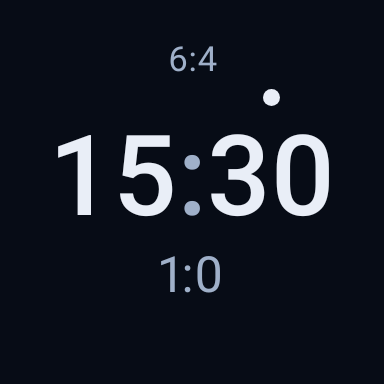
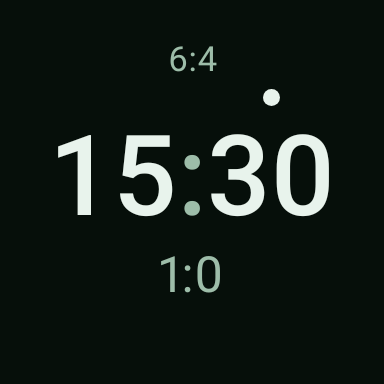
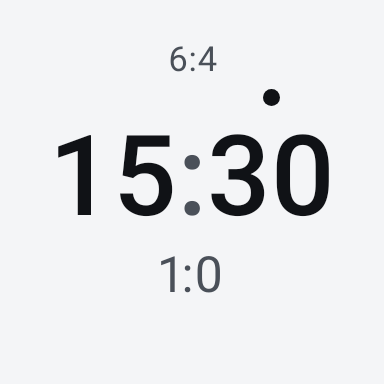
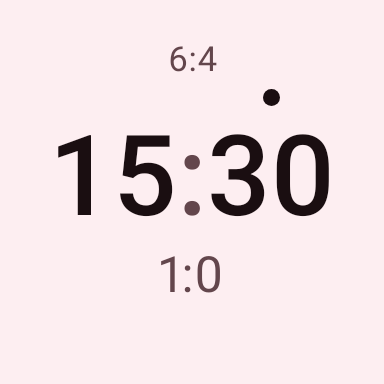
Ten built-in looks, switched on the watch — five dark, five light. Each one is an ordinary theme document, and every one of them passes the same contrast check as anything downloaded later, so none can leave you with a score you cannot read in the sun.
Which sports it counts
Counted, with a page each
Three ways of counting. Tennis and padel share the 15, 30, 40 ladder — all 14 formats work for either, golden point included. Table tennis, badminton, squash, pickleball and volleyball are races to 11, 15, 21 or 25, two clear, with the serve following the rules of each, the changes of ends called when they fall due, and a volleyball set's opener asked where a toss decides it. Football, handball and basketball are a running tally: a tap per goal, two per basket with a quick correction to one or three, halves or quarters with a countdown and overtime where the format has it, or a final whistle you record — a draw included.
Not yet
A stopped basketball clock and penalties; who scored and who came on; and the old side-out scoring where only the serving side can win a point.
Measured, not counted
Thirteen more sports have no score to keep, so the watch measures instead: heart rate, calories, and — where it makes sense — steps and distance. The session is filed under the sport you set. How a session works
Your club plays something else? Write and tell us what it is and how a match is scored. What we hear back decides the order we build in.
Something broken, something missing
Two kinds of mail are equally welcome, and the second is the one that decides what gets built next: a bug you ran into on court, and a feature the app does not have yet. Tell us what you wanted to do — not what you think we should change — and the reason usually survives the trip better.
For a bug, four lines beat a long description:
- Which watch — the model, not only the brand
- Which Wear OS version
- Which Courtovo version, from Settings → About
- What you did, and what happened instead
No account, no form and no ticket number. It arrives as an email and a person reads it.
For clubs
Courtovo works entirely on its own and stays free. If your club uses Joinovo, the two are now connected: the line-up comes from the court booking instead of the keyboard, finished matches land in your member profile, and what your watch measured goes with them only if you consent to it.